The Olympus OM System: A Retrospective
- Michael Elliott

- 2 hours ago
- 8 min read
If you have spent any time around film photography, you will have encountered the Olympus OM system. Launched in 1972 with the M-1 (quickly renamed the OM-1 after a complaint from Leica), the OM line represented a direct challenge to the prevailing logic of SLR design. Where other manufacturers were building cameras that grew heavier and more complex with each generation, Olympus went the other way. The OM-1 was smaller, lighter, and quieter than almost anything else with a reflex mirror behind the lens mount. It was, by any honest measure, a paradigm shift.
The system ran for over two decades, producing four main bodies and one of the finest lens catalogues in 35mm photography. If you shoot film today, an OM body paired with a Zuiko lens remains one of the best value propositions available. This retrospective covers the full arc — the bodies, the lenses, the accessories, and the question of whether the OM system still deserves a place in your bag in 2026.
The Origin: Yoshihisa Maitani and the OM-1
The OM system was the work of Yoshihisa Maitani, the same designer responsible for the Olympus Pen half-frame cameras and the XA compact. Maitani's obsession was miniaturisation without compromise. The brief for what became the OM-1 was straightforward: build a professional-grade SLR that weighed and measured significantly less than a Nikon F2 or Canon F-1, without sacrificing viewfinder brightness, mechanical reliability, or system expandability.
He achieved this through a series of elegant engineering decisions. The mirror box was shortened by moving the meter cell into the mirror housing rather than mounting it around the focusing screen. The shutter speed dial was moved from the top plate to a ring around the lens mount, freeing space and reducing the prism housing height. The film advance lever was redesigned to sit closer to the body. Individually, these changes were incremental. Together, they produced a camera that was roughly 35% smaller by volume than its competitors while matching or exceeding their specification sheets.

The OM-1, released in 1972, was a fully mechanical camera with a horizontal cloth focal-plane shutter running from 1 second to 1/1000th, plus Bulb. It offered match-needle centre-weighted metering powered by a 1.35V mercury cell (a source of ongoing annoyance now that mercury cells are banned in most countries — more on that later). The viewfinder was exceptionally bright, with 97% coverage and 0.92x magnification. It accepted motor drives, was rated for temperatures well below freezing, and weighed 510 grams without a lens. For context, a Nikon F2 Photomic weighed 715 grams.
The Bodies: OM-1 Through OM-4Ti
OM-1 and OM-1n
The original OM-1 is the purist's choice. Fully mechanical, no battery dependency for shutter operation, and built with a solidity that belies its size. The OM-1n, released in 1979, added a dedicated flash connector on the hotshoe for the T-series flash units and improved the flash sync circuitry, but was otherwise identical. Both are excellent cameras. The main practical issue is the mercury battery — the original meter was calibrated for a 1.35V cell. Your options are a Wein cell (correct voltage but short lifespan), a modern zinc-air hearing aid battery (close enough, around 1.4V), or a professional CLA that includes a voltage adjustment. If you shoot with the Sunny 16 rule, the meter becomes a secondary concern anyway.
OM-2 and OM-2n
The OM-2, released in 1975, introduced aperture-priority automatic exposure to the system. More significantly, it pioneered OTF (off-the-film) metering — the camera measured light reflected off the film plane during exposure, enabling accurate auto-exposure even in difficult lighting and proper TTL flash metering. This was genuinely novel technology at the time. The OM-2n refined the design with improved flash compatibility and a self-timer. The trade-off is battery dependency: unlike the OM-1, the OM-2 requires battery power for all shutter speeds. The electronically controlled shutter is also more expensive to repair if it fails. For photographers who value automation and shoot with flash regularly, the OM-2n is the strongest all-round choice in the system.
OM-3 and OM-3Ti
The OM-3, released in 1983, returned to a fully mechanical shutter with the addition of multi-spot metering — you could take up to eight spot readings and the camera would average them, displayed on an analogue scale in the viewfinder. The OM-3Ti, released in 1994, added titanium top and bottom plates and a highlight/shadow metering mode. Both are superb cameras for photographers who want mechanical reliability with sophisticated metering. They are also the rarest and most expensive bodies in the system. An OM-3Ti in good condition regularly commands prices north of £500, sometimes significantly more. Whether that premium is justified depends on how much you value the mechanical shutter and multi-spot combination. For most photographers, an OM-1n with a handheld meter will deliver the same results for a fraction of the cost.
OM-4 and OM-4Ti
The OM-4 (1983) combined the OM-2's aperture-priority auto with the OM-3's multi-spot metering. The OM-4Ti (1989) added titanium construction and improved electronics. These are the most capable bodies in the system, offering the widest range of metering options and the most refined shooting experience. The OM-4Ti is often considered the high point of the OM line, and priced accordingly. The electronically controlled shutter means battery dependency, but in practice this is rarely a problem unless you are shooting in extreme cold for extended periods.

The Zuiko Lens System
The lenses are the real story. Olympus produced over forty Zuiko lenses for the OM mount, ranging from the 8mm f/2.8 fisheye to the 1000mm f/11 reflex. The build quality is consistently excellent — all-metal construction with smooth, well-damped focusing rings and positive aperture clicks. Optically, the Zuiko range holds up remarkably well by modern standards, and in some cases surpasses contemporary lenses at equivalent price points.
The 50mm f/1.8 is the standard kit lens and a genuinely good optic — sharp from f/2.8 onward, with pleasant rendering wide open. The 50mm f/1.4 adds one stop and slightly nicer bokeh at the expense of weight and cost. For most shooters, the f/1.8 is the better value. The 28mm f/2.8 is a compact wide-angle that punches above its weight, and the 135mm f/2.8 is one of the sharpest portrait lenses in any vintage mount. If you want one lens to pair with an OM body for street photography, the 40mm f/2 pancake is difficult to beat — it transforms the OM-1 into something barely larger than a rangefinder.
The 21mm f/2, 24mm f/2, 85mm f/2, and 100mm f/2 are all outstanding lenses that command higher prices due to their quality and relative scarcity. The 90mm f/2 macro is regarded by many as one of the finest macro lenses ever made in any mount, period. If you are building an OM system from scratch, start with the 50mm f/1.8 and add from there based on the focal lengths you actually use.

Accessories and System Depth
Olympus built the OM system with professional expandability in mind. Motor drives were available for all bodies (the Motor Drive 1 for the OM-1/2, the Motor Drive 2 for the OM-3/4), offering continuous shooting at up to 5 frames per second. The Winder 1 and Winder 2 provided single-frame advance for a lighter, simpler motorised option. The T-series flash units (T20, T32, T45) offered TTL flash metering when paired with the OM-2 and later bodies. Extension tubes, bellows, and a dedicated macro flash system rounded out a remarkably complete ecosystem.
Interchangeable focusing screens were available across the range, with thirteen different options covering everything from split-image to microprism to grid and clear matte screens. This modularity meant you could optimise the viewfinder for your style of shooting — a clear matte screen for manual focus with long lenses, a split-image screen for fast street work, a grid screen for architectural photography.
Buying an OM System in 2026
Prices have climbed noticeably since the film photography resurgence, but the OM system remains more affordable than comparable Leica, Nikon, or Contax gear. An OM-1n in good working condition can be found for £80–£150. An OM-2n typically runs £100–£180. The OM-4Ti, being the desirable top-of-line model, commands £200–£400. Zuiko lenses vary widely, but the 50mm f/1.8 can still be had for under £40, and even the excellent 28mm f/2.8 rarely exceeds £80. For a broader comparison of what else is available at these price points, the best 35mm film cameras roundup puts the OM system in context against the competition.
When buying, the key things to check are the light seals (they perish with age and cause light leaks — replacement is a straightforward DIY job or a cheap professional service), the meter accuracy (test against a known reference or phone app), and the shutter curtain condition on the OM-1/OM-1n (the horizontal cloth shutter can develop pinholes over decades). On the OM-2 and OM-4, confirm that all electronic shutter speeds are functioning, particularly the slow speeds below 1/30th.
Practical Exercises
If you own or are considering an OM body, these exercises will help you understand the system's strengths and develop your handling.
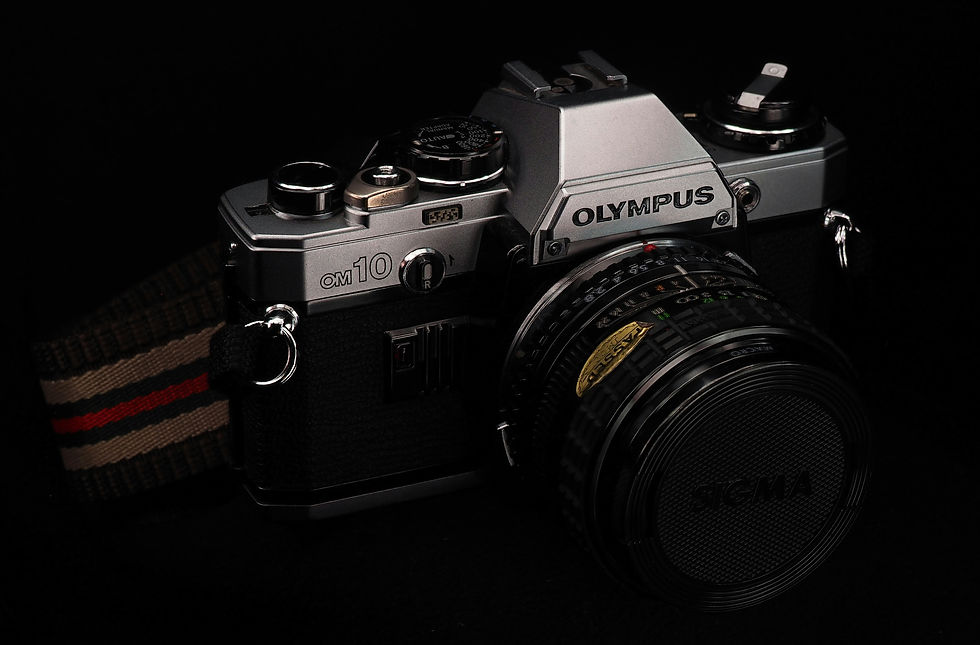
First, spend a roll shooting with the 50mm f/1.8 at a single aperture — f/5.6 is a good starting point. Olympus designed the OM shutter speed ring to be adjusted with the left hand while the right hand stays on the film advance and shutter release. Practice this two-handed workflow until it becomes instinctive. It is faster than it looks.
Second, if you have an OM-1 or OM-1n, try shooting a full roll using only the Sunny 16 rule — no meter. The OM-1 is a mechanical camera and will fire without a battery. This exercise strips away dependency on electronics and forces you to read the light. It connects directly to the discipline that Maitani's design philosophy encouraged: fewer barriers between the photographer and the photograph.
Third, if you have access to more than one Zuiko focal length, shoot the same subject — a familiar street corner, a friend, a still life — with each lens from a distance that fills the frame similarly. Compare the results not for sharpness but for perspective compression, background separation, and the feel of each image. Understanding how focal length changes the relationship between subject and background is one of the most valuable things you can learn with a system camera, and the OM system makes it easy to experiment.
The Legacy
The OM system did not save Olympus. By the late 1990s, autofocus had won, and Olympus's late and unconvincing AF SLRs never gained traction against Canon and Nikon. The last OM body, the OM-2000 (actually manufactured by Cosina), was a budget offering that had little in common with Maitani's original vision. But legacy is not measured by market share. The OM system proved that a professional camera could be small, light, and refined without sacrificing capability. It influenced a generation of compact SLR designs — much as the Rolleiflex had done for twin-lens reflexes decades earlier — and the Zuiko lenses set a standard for optical quality that many modern manufacturers still reference.
For film photographers in 2026, the practical case for an OM system is simple. The bodies are reliable, the lenses are superb, and the handling is among the best ever achieved in a mechanical SLR. It is not a system for the spec-sheet obsessive or the collector who never shoots. It is a system for photographers who want a tool that gets out of the way and lets them concentrate on making pictures. Maitani would have approved.


Comments